Reports and Course Summary
Reports and Course Summary
Design and Implementation Documentation
Expertiza Reimplementation Back-End
Overview
The reporting subsystem was ported from the original Expertiza codebase (referred to as Repo X) into the reimplemented Rails API back-end (referred to as Repo Y) and redesigned in the process.
Repo X used a Rails helper module (ReportFormatterHelper) that assigned instance variables, such as @reviewers and @review_scores, for ERB views.
Since Repo Y is a JSON API with no views, instance variables are not applicable. The architecture was therefore redesigned around a streaming reduce pipeline that returns plain Ruby hashes rendered as JSON.
Design Goals
- Avoid loading entire result sets into memory at once.
- Keep domain-specific computation out of the base class.
- Make each report type independently composable and testable.
- Fix N+1 query patterns present in Repo X.
Anti-Patterns Addressed
The design directly addresses two anti-patterns identified during architectural review of Repo X.
The fetch_responses Anti-Pattern
Repo X loaded all response records into an unnamed, ad-hoc array before processing:
# WRONG
responses = fetch_responses   # full memory load
grouped   = group(responses)
metrics   = compute_metrics(grouped)
This forces the entire result set into Ruby memory, prevents streaming, and makes the intermediate structure implicit.
The fix is to never materialise all rows at once. Instead, use find_each to stream records in batches, so memory usage scales with the number of groups, not the number of raw rows.
Default Metrics in the Base Class
Repo X placed domain-specific math directly in the base class:
# WRONG — in BaseReport
def compute_metrics(grouped)
  grouped.transform_values do |responses|
    {
      count:     responses.size,
      avg_score: responses.map(&:score).sum / responses.size.to_f
    }
  end
end
This ties every subclass to one particular shape of computation. The fix is to move all domain math into per-report accumulator logic. The base class contains zero domain math.
What "Domain Math" Means
Domain math refers to the business-logic calculations specific to a particular report type.
| Report | Its domain math |
|---|---|
| Review scores | (raw_score / max_score) * 100 — percentage score per reviewer per round
|
| Avg/ranges | max, min, sum / size — score aggregates across a team's reviewers
|
| Feedback | Bucket response IDs into round_1, round_2, round_3 arrays
|
| Bookmark rating | Collect distinct bookmark IDs into a Set |
Rule: BaseReport only defines how to run the pipeline — stream, group, fold, finalize. The what to compute belongs entirely inside each report's own accumulate and finalize methods.
Architecture: The Streaming Pipeline
Pipeline Shape
All reports are built on a single pipeline template defined in Reports::BaseReport:
def run
  state = initial_state
  source.find_each(batch_size: 500) do |row|
    accumulate(state, grouper.call(row), row)
  end
  finalize(state)
end
The pipeline consists of four concerns:
| Concern | Responsibility |
|---|---|
| Source | ActiveRecord relation streamed via find_each. Subclasses use includes(...) to eagerly load associations and prevent N+1 queries.
|
| Grouper | A lambda (row) -> key that determines how rows are bucketed in the accumulator state.
|
| Accumulate | Folds one row into the state in place. Contains all domain-specific math for that report. |
| Finalize | Post-processes the finished state into the output hash. Default implementation returns state unchanged. |
Memory Model
State grows proportional to the number of groups (such as distinct reviewers), not the number of raw rows.
For example, a dataset with 10,000 responses across 20 reviewers keeps only 20 entries in the accumulator state at any point.
Base Class Definition
module Reports
  class BaseReport
    def initialize(assignment)
      @assignment = assignment
    end

    def run
      state = initial_state
      source.find_each(batch_size: 500) do |row|
        accumulate(state, grouper.call(row), row)
      end
      finalize(state)
    end

    private

    def source        = raise NotImplementedError
    def grouper       = raise NotImplementedError
    def initial_state = raise NotImplementedError

    def accumulate(_state, _key, _row)
      raise NotImplementedError
    end

    def finalize(state) = state
  end
end
Controller
Dispatch Mechanism
The controller uses a constant hash to map type strings to report classes, replacing the send(type) meta-programming pattern used in Repo X.
REPORT_CLASSES = {
  'review_response_map'          => Reports::ReviewReport,
  'feedback_response_map'        => Reports::FeedbackReport, # To be implemented
  'teammate_review_response_map' => Reports::TeammateReviewReport,
  'bookmark_rating_response_map' => Reports::BookmarkRatingReport, # To be implemented
  'basic'                        => Reports::BasicReport
}.freeze

def response_report
  type         = params.dig(:report, :type) || params[:type] || 'basic'
  report_class = REPORT_CLASSES[type]

  unless report_class
    return render json: { error: "Unknown report type: #{type}" },
                  status: :unprocessable_entity
  end

  assignment = Assignment.find(params[:assignment_id] || params[:id])
  data = report_class.new(assignment).run
  render json: { type: type, assignment_id: assignment.id }.merge(data)
end
Routes
GET  /reports/response_report?assignment_id=<id>&type=<type>
POST /reports/response_report
PATCH /review_reports/:id/update_grade
Report Implementations
Review Report (review_response_map)
The review report is the most complex. It is implemented as a coordinator class (ReviewReport) that runs three independent inner pipelines and merges their results.
| Pipeline | Source | Groups by | Produces |
|---|---|---|---|
| ReviewersPipeline | ReviewResponseMap | reviewer_id | Sorted reviewer list |
| ScoresPipeline | Response JOIN map | reviewer_id | Score percentage per round/reviewee |
| AvgRangesPipeline | Response JOIN map | [reviewee_id, round] | Max/min/avg per team/round |
N+1 Fix: Precomputed Max Question Score
Repo X called response.maximum_score inside the accumulation loop, resulting in one query per response. In Repo Y, both score pipelines precompute a round -> max_question_score map with a single query before the pipeline runs:
def precompute_max_q_scores
  AssignmentQuestionnaire
    .joins(:questionnaire)
    .where(assignment_id: @assignment.id)
    .pluck(:used_in_round, 'questionnaires.max_question_score')
    .to_h
end

# Used inside accumulate:
max_score = total_wt * (@max_q_score[round] || @max_q_score[nil] || 1)
Sample Response
{
  "type": "review_response_map",
  "assignment_id": 1,
  "reviewers": [
    { "id": 5, "user_id": 2, "name": "alice",
      "full_name": "Alice Smith", "handle": "alice" }
  ],
  "review_scores": { "5": { "1": { "3": 87.5 } } },
  "avg_and_ranges": { "3": { "1": { "max": 92.0, "min": 75.0, "avg": 83.5 } } }
}
Feedback Report (feedback_response_map)
Produces the list of authors and the IDs of review responses that received author feedback, bucketed by round for varying-rubric assignments.
Deduplication uses a Set (O(1) lookup), rather than the array-based seen_map_round_keys.include? from Repo X (O(n) lookup). Authors are fetched once in finalize, not inside the stream.
Sample Response (varying rubrics)
{
  "type": "feedback_response_map",
  "authors": [{ "id": 7, "name": "bob", "full_name": "Bob Jones" }],
  "review_response_ids": {
    "round_1": [12, 15], "round_2": [18], "round_3": []
  }
}
Teammate Review Report (teammate_review_response_map)
Streams TeammateReviewResponseMap records grouped by reviewer_id. The first occurrence per reviewer is kept using deduplication via early return. Reviewer associations are eagerly loaded.
See the TeammateReviewReportPage section for the corresponding frontend.
Sample Response
{
  "type": "teammate_review_response_map",
  "reviewers": [
    { "reviewer_id": 5, "user_id": 2,
      "name": "alice", "full_name": "Alice Smith" }
  ]
}
Bookmark Rating Report (bookmark_rating_response_map)
To be implemented.
Basic Report (basic)
Returns minimal assignment metadata. No streaming is required since all data comes from the already-loaded Assignment object. Used as the default when no type parameter is provided.
Sample Response
{
  "type": "basic",
  "assignment_id": 1,
  "assignment": {
    "id": 1, "name": "Project 1",
    "num_review_rounds": 2,
    "varying_rubrics_by_round": true
  }
}
Course Grade Summary
Instructor-facing endpoint that aggregates peer scores and instructor grades per student per assignment within a course. Lives in CourseReportsController, which includes PenaltyHelper.
Route:
GET /courses/:id/course_report/grade_summary
Key computations:
- Peer score —
precompute_peer_scoresbulk-loads allReviewResponseMaprecords for the course in one query, computing weighted average percentage scores per (assignment, team) pair. Reviewer weight comes fromReviewGrade#grade_for_reviewer; defaults to 1.0 if absent. - Instructor grade —
team.grade_for_submissionminus the late penalty fromPenaltyHelper#get_penalty(participant_id)[:submission]. Returnsnilwhen no grade has been set. - Penalty guard —
get_penaltyreturns{ submission: 0, review: 0, meta_review: 0 }immediately when the assignment has no late policy (@penalty_per_unitis nil), avoiding constant-lookup errors forMetareviewResponseMap. - Calibrated assignments excluded — assignments where
is_calibrated: trueare filtered out. - Empty assignments excluded — assignments with no participants are rejected from the response.
def precompute_peer_scores(assignment_ids, team_ids)
  return {} if team_ids.empty?

  maps = ReviewResponseMap
    .where(reviewed_object_id: assignment_ids, reviewee_id: team_ids)
    .includes(responses: :scores)

  reviewer_grades = ReviewGrade
    .where(participant_id: maps.map(&:reviewer_id).uniq)
    .index_by(&:participant_id)

  weighted = Hash.new { |h, k| h[k] = { sum: 0.0, weight: 0.0 } }
  maps.each do |map|
    w = reviewer_grades[map.reviewer_id]&.grade_for_reviewer || 1.0
    map.responses.select(&:is_submitted).each do |resp|
      max = resp.maximum_score
      next if max.zero?
      pct = resp.aggregate_questionnaire_score.to_f / max * 100
      weighted[[map.reviewed_object_id, map.reviewee_id]][:sum]    += pct * w
      weighted[[map.reviewed_object_id, map.reviewee_id]][:weight] += w
    end
  end

  weighted.transform_values { |v| (v[:sum] / v[:weight]).round(2) }
end
Sample Response:
{
  "course_id": 1,
  "course_name": "CSC 517",
  "assignments": [{ "id": 10, "name": "Project 1", "has_topics": true }],
  "rows": [
    {
      "user_id": 5,
      "user_name": "alice",
      "assignments": [
        {
          "assignment_id": 10,
          "assignment_name": "Project 1",
          "topic": "Machine Learning",
          "peer_score": 87.5,
          "instructor_grade": 85.0
        }
      ],
      "final_grade": 85.0
    }
  ]
}
Course All Reviews
Aggregates teammate review scores received per student per assignment within a course. Companion endpoint to grade summary.
Route:
GET /courses/:id/course_report/all_reviews
Key computations:
- Teammate scores —
precompute_teammate_scoresbulk-loadsTeammateReviewResponseMaprecords and returns{ participant_id => "avg%" }. - Teammate count —
precompute_teammate_countscounts distinct teammates per user across all assignments in the course.
Sample Response:
{
  "course_id": 1,
  "course_name": "CSC 517",
  "assignments": [{ "id": 10, "name": "Project 1" }],
  "rows": [
    {
      "user_id": 5,
      "user_name": "alice",
      "teammate_count": 2,
      "assignments": [
        { "assignment_id": 10, "assignment_name": "Project 1", "teammate_review": "83%" }
      ],
      "aggregate": "83%"
    }
  ]
}
ReviewGrade Model
Stores an instructor's grade and comment for a reviewer participant. Created alongside the Review Report frontend to support the grade/comment save workflow.
Migrations:
# 20260810135129_create_review_grades.rb
create_table :review_grades, if_not_exists: true do |t|
  t.integer  :participant_id, null: false, index: { unique: true }
  t.float    :grade_for_reviewer
  t.text     :comment_for_reviewer
  t.integer  :grader_id
  t.timestamps
end
# 20260813000001_add_instructor_grade_scores_to_assignments.rb
add_column :assignments, :instructor_grade_min_score, :integer
add_column :assignments, :instructor_grade_max_score, :integer
These two columns back the instructor_grade_min_score and instructor_grade_max_score fields exposed in assignment_params. The frontend's GradeCommentCell uses them to determine the valid grade range and warn instructors when a saved grade would fall outside it.
Endpoint:
PATCH /review_reports/:id/update_grade
# params: { grade_for_reviewer:, comment_for_reviewer: }
# :id is the participant_id (AssignmentParticipant)
Known limitation: ReviewGrade is per-participant (one row per reviewer), not per response-map. This means the grade/comment field appears on every row for a reviewer in the UI. This matches the original Expertiza schema and is deferred.
Frontend Architecture and Renders
The following React/TypeScript pages implement the instructor-facing report views. All pages are gated behind instructor privileges.
Assignments
Few changes have been done to the assignment pages to include the reports and instructor grading scales.
-
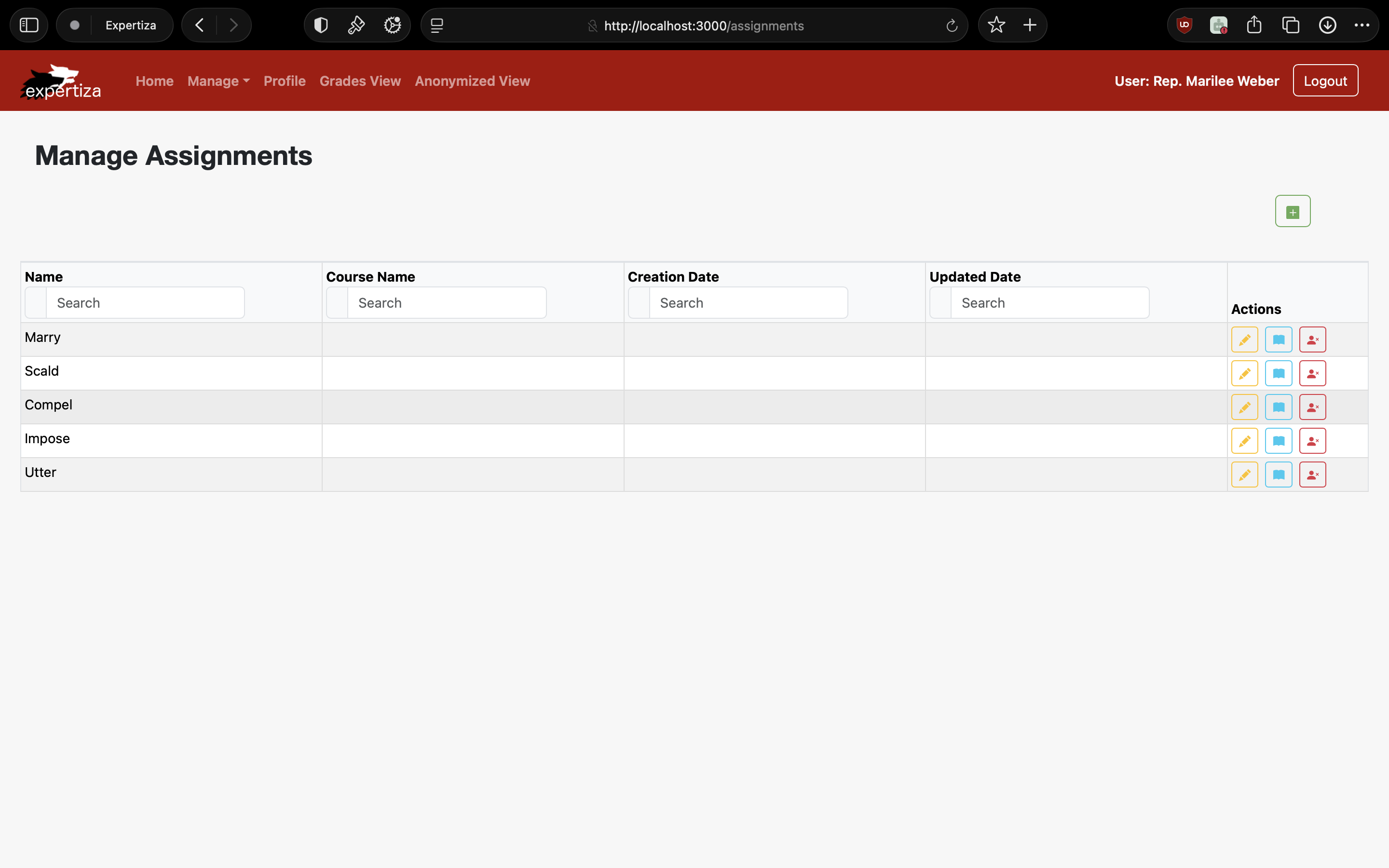
This is the Assignments tab for an instructor/admin.
-
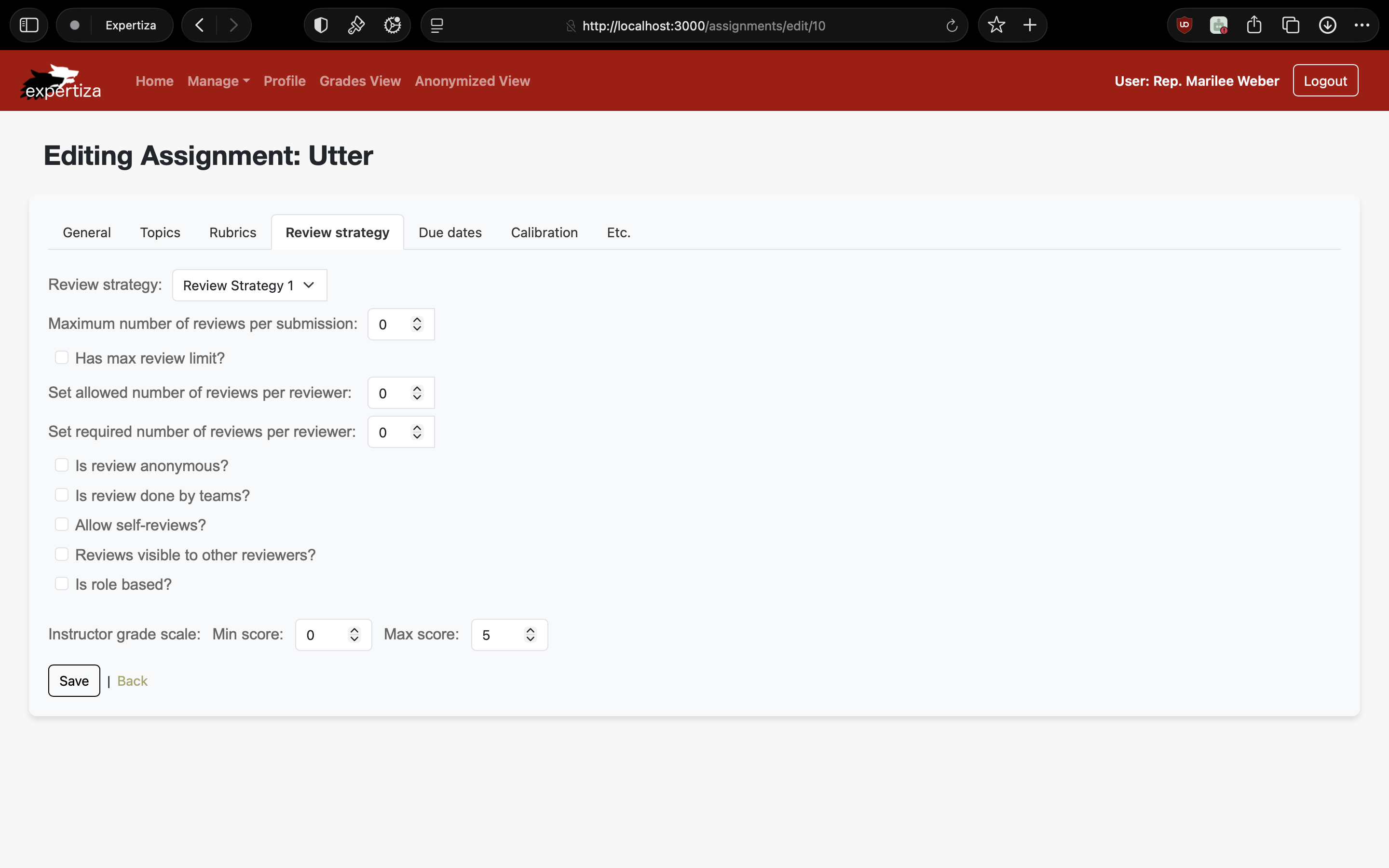
Review the strategy tab for an assignment where min and max scores for the reviews can be set.
-
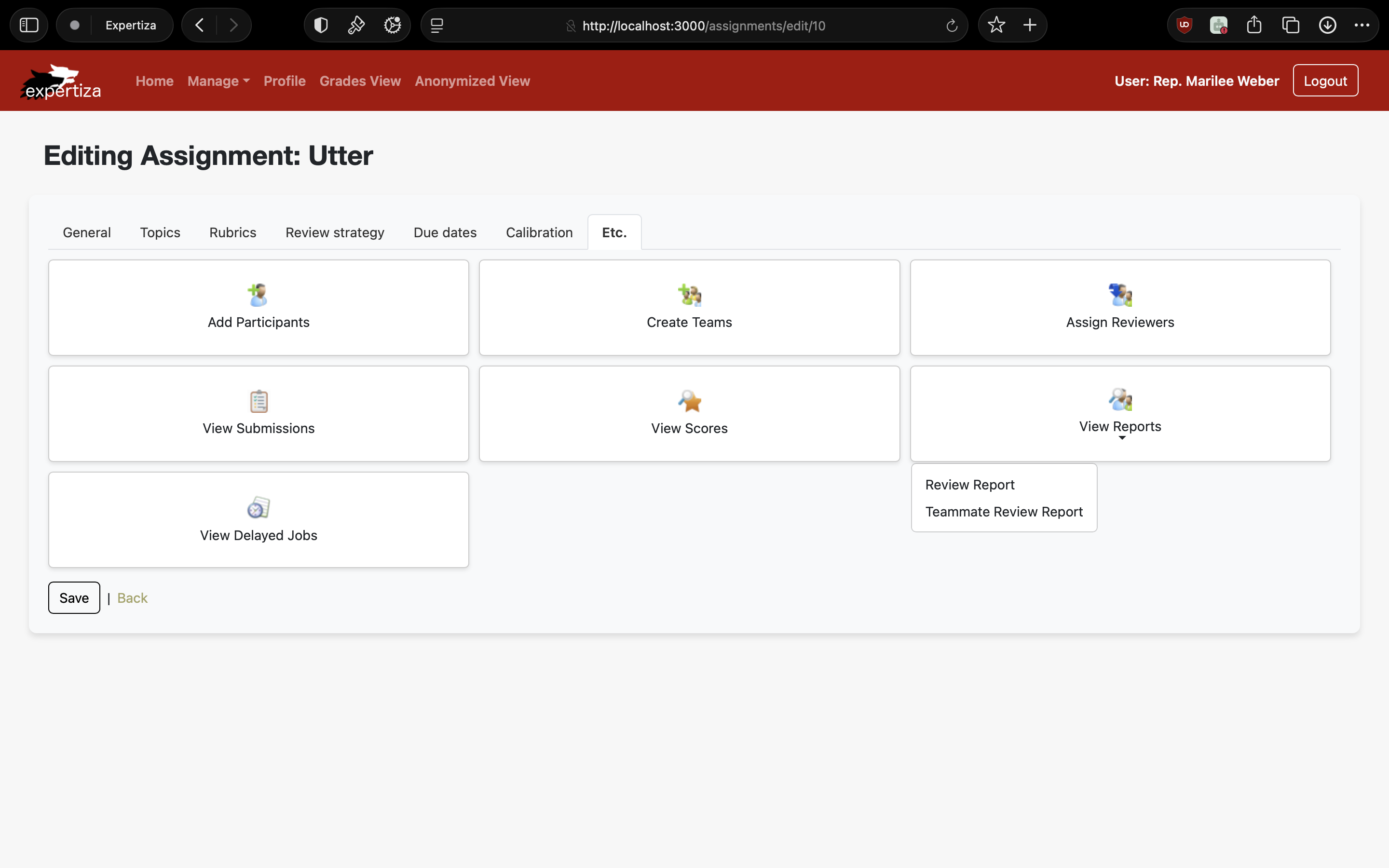
The implemented reports have been listed in the View Reports button.


ReviewReportPage
File: src/pages/ReviewReportPage/ReviewReportPage.tsx
- Rounds 1–5 visibility toggled per reviewer row
- MetricsChart — per-round averages with a Total bar; rounds where a reviewer did not participate are suppressed from the chart entirely
- Status color coding per reviewer, including brown pre-population on reload from
reviewer_gradesin the fetch response - Scores awarded and average score display
- Grade/comment save via
PATCH /review_reports/:id/update_grade - CSV export, column sorting, search filter
- Summary modal per reviewer
- Color cutoffs at 90/80/70/60 (A/B/C/D scale) via
getColorClass - Dynamic color bands via
scoreToColor()—k = min(maxScore, 10)HSL bands, green → red spectrum - Coloring relative to observed data range (dataMin/dataMax per round), not absolute rubric max
- Review metrics column narrowed;
barGap=1;slotWidth=75pxbetween groups
-
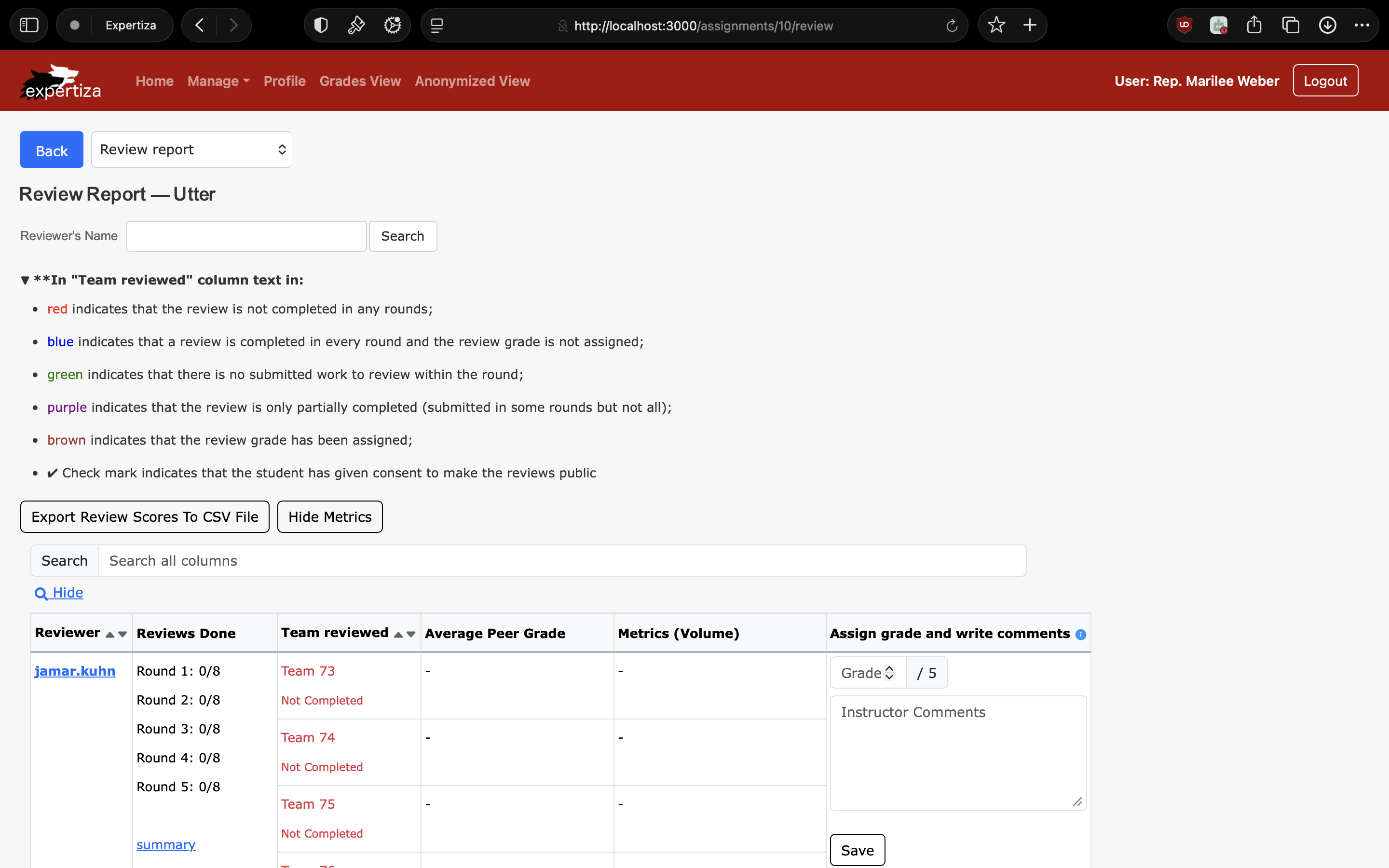
The Review Report page showing reviewer scores and reviewer grade for an assignment with a collapsible legend.
-
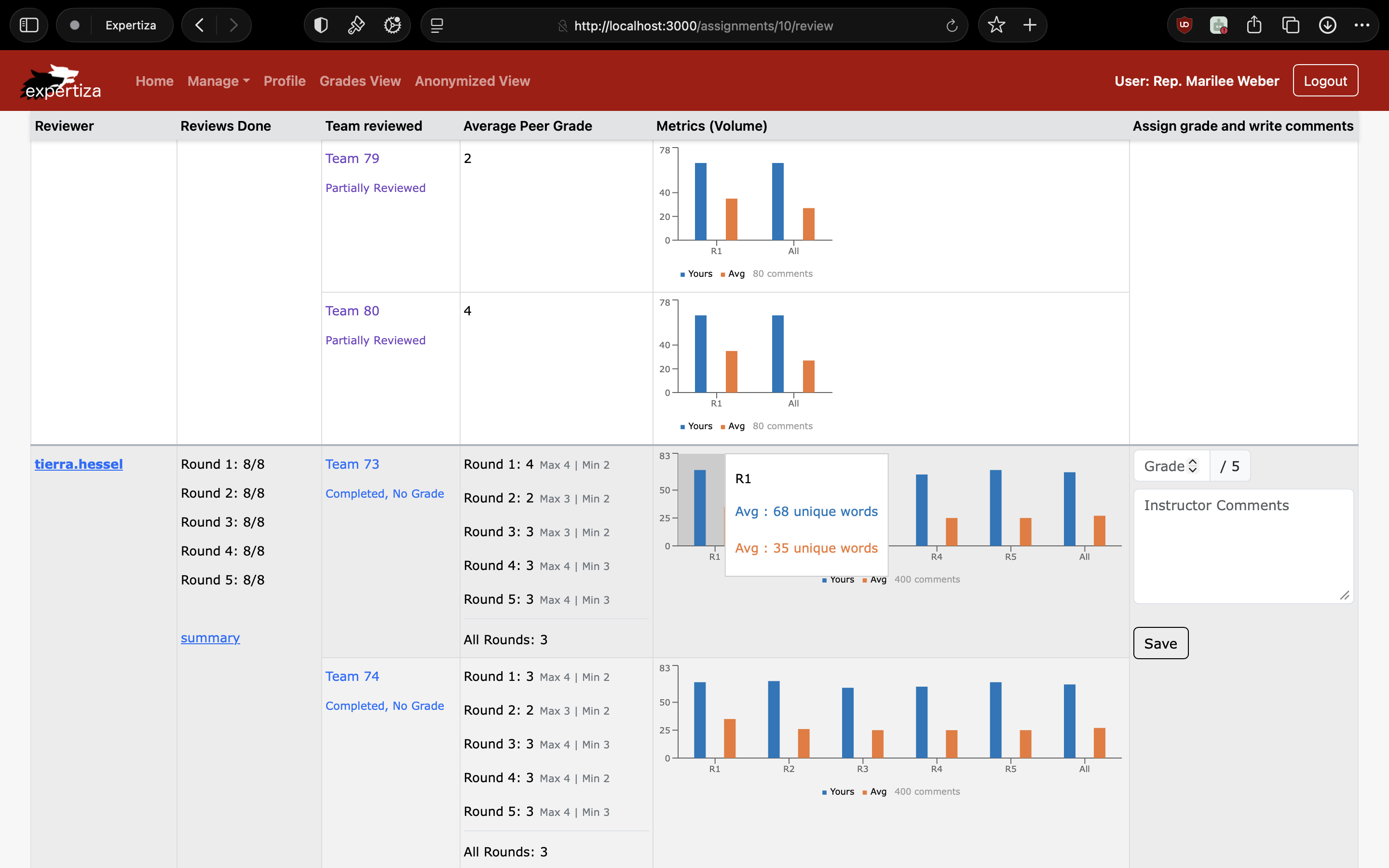
The Review Report page (with sticky headers) showing reviewer scores and visual metrics comparing the reviewer and average.
-

The Review Report page summary button for a reviewer redirects to a new tab with the reviews done segregated by team and round with heatgrid styling enabled.


TeammateReviewReportPage
File: src/pages/TeammateReviewReportPage/TeammateReviewReportPage.tsx
- Team grouping column
- View modal showing scores per reviewee
- Assignment name heading
- Compact layout:
p-3container,line-height: 1.4, padding6px 24px 6px 8pxon th/td tableStyle=Template:Width: "fit-content"— table shrinks to content, no full-width stretch- "Reviews" header on the view-link column
- CSS scoped under
.teammate-review-report-page(does not affect Review Report) - Status color
#dc3545for below-threshold scores
-

The Teammate Review Report page showing the status of reviews required by teammates about each other.
-

Detailed teammate reviews page redirected from the previous Teammate Review Report page view button


Courses
Few changes have been done to the courses page to redirect to the new course reports. Two new buttons have been made for that. Each assignment in a course has a button to redirect to the ReviewReport page of that assignment.
-
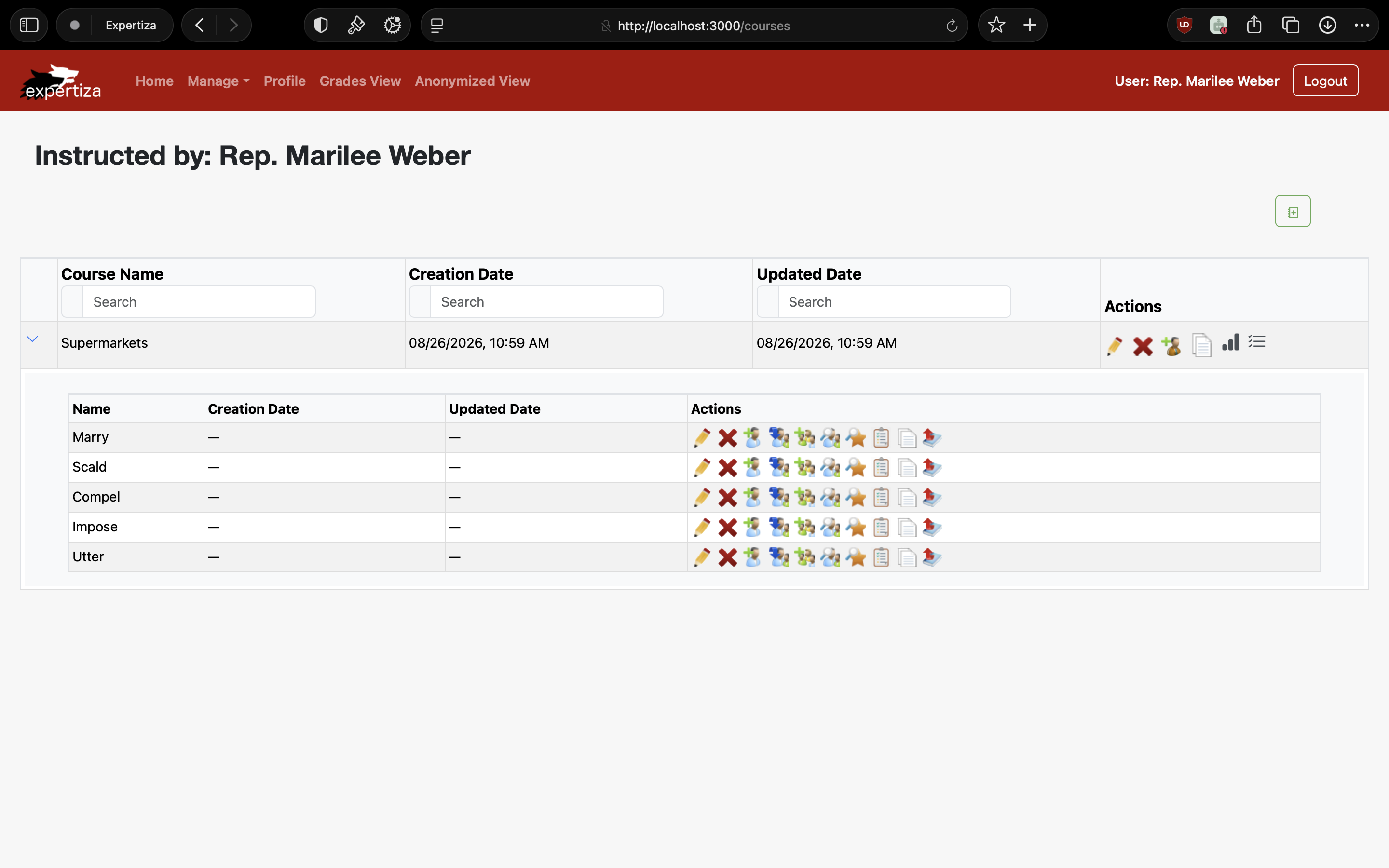
This is the courses tab accessed by instructors/admin.

Course Report Pages
Accessible from the course list: expand a course → assignment row → "View Review Report" button.
| Page | Frontend Route | Backend Endpoint |
|---|---|---|
CourseGradeSummaryPage |
courses/:courseId/course-report/grade-summary |
GET /courses/:id/course_report/grade_summary
|
CourseAllReviewsPage |
courses/:courseId/course-report/all-reviews |
GET /courses/:id/course_report/all_reviews
|
Both pages render a heat-grid layout where each cell's color is determined by the value's position in the observed data range (not a fixed rubric max).
-
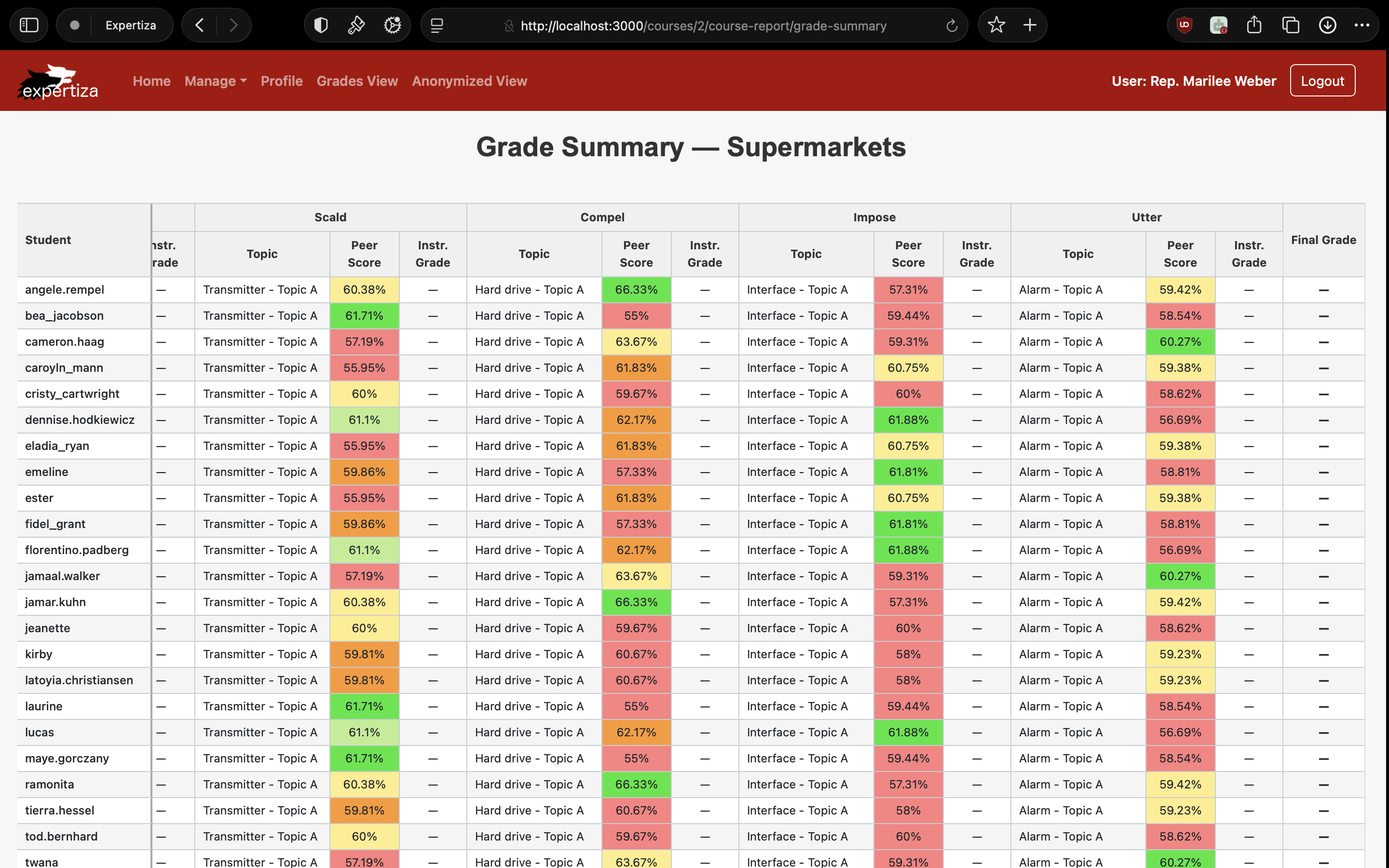
A horizontal scroll and heatstyle enabled table which shows detailed grade distribution for each students in the course per assignment.
-

A horizontal scroll and heatstyle enabled table which shows detailed teammate reviews given and received by each teammate per assignment.
-
The Review Report page summary button for a reviewer redirects to a new tab with the reviews done segregated by team and round with heatgrid styling enabled.


src/utils/heatgridUtils.ts
getHeatColorClass(value, dataMin, dataMax)— relative coloring, maps value to a CSS class based on its position betweendataMinanddataMax.getColorClass(score)— absolute grade-scale coloring (90/80/70/60 cutoffs).
src/utils/reviewTypes.ts
- Exports
ReviewDataandSectionHeaderDatainterfaces. Re-exported fromViewTeamGrades/App.tsx.
Heat grid CSS (in custom.scss, global, after Bootstrap import, with !important):
.c5 { background: #1a7a4a; color: #fff; }  /* A — high */
.c4 { background: #5cb85c; }               /* B */
.c3 { background: #f0ad4e; }               /* C */
.c2 { background: #d9534f; color: #fff; }  /* D */
.c1 { background: #8b1a1a; color: #fff; }  /* F — low */
.c0 { background: #e0e0e0; }               /* no data */
.cf { background: #f8f8f8; }               /* empty */
Frontend Routes (App.tsx)
courses/:courseId/course-report/grade-summary  →  CourseGradeSummaryPage
courses/:courseId/course-report/all-reviews    →  CourseAllReviewsPage
Dropdown on the Review Report page: Review Report | Teammate Review Report. (Per Team report removed — no counterpart in Repo X.)
Authorization Changes
| Controller | Change | |
|---|---|---|
AssignmentsController |
Added action_allowed? → current_user_has_instructor_privileges?. Previously defaulted to true — any user could CRUD assignments.
| |
CoursesController#index |
Scoped to Course.where(instructor_id: current_user.id). Admins still see Course.all.
| |
AssignmentsController#index |
Scoped to instructor's own assignments plus assignments under their courses. Admins see Assignment.all.
| |
ReportsController |
action_allowed? now checks current_user_has_admin_privileges? |
current_user_teaching_staff_of_assignment?. Removed overly broad instructor_privileges?.
|
CourseReportsController |
New controller; auth: current_user_has_instructor_privileges?.
|
RSpec Test Coverage
| Spec file | Covers |
|---|---|
spec/requests/api/v1/review_reports_controller_spec.rb |
Response report fetch, update_grade endpoint |
spec/requests/api/v1/review_grade_conflicts_spec.rb |
ReviewGrade conflict detection endpoint |
spec/requests/api/v1/course_reports_controller_spec.rb |
grade_summary (incl. has_topics flag, weighted peer scores, penalty integration), all_reviews |
spec/requests/api/v1/teammate_review_report_spec.rb |
Teammate review report endpoint |
spec/models/response_map_spec.rb |
Added .compute_average_reviewer_score describe block (8 cases, uses instance_double)
|
spec/requests/api/v1/assignment_controller_spec.rb |
show/update with AQ data, instructor_grade_min/max fields |
Pending Roadmap
Items identified in the 2026-08-19 team meeting, not yet implemented:
- Info button on the heat grid explaining relative coloring (displayed max ≠ 100)
- Toggle to show/hide the metrics/chart column
- "Volume" column header label derived from active metrics (not hardwired)
- Move rubric scale indicator (e.g. /5, −2 to 2) to column header — not repeated per cell
- Partial review display: exclude incomplete rounds from averages; use purple; show timestamp / em-dash per round
- Grade change warning banner when instructor lowers max points below an already-assigned score
Previously completed from the same meeting:
- Color cutoffs changed to 90/80/70/60 (A/B/C/D scale)
- Dynamic color bands via
scoreToColor() - "Question" column header renamed to "Item" in heatgrid and feedback table
/100hardcoded scale label removed from GradeCommentCell- Avg bar suppressed for rounds where reviewer did not participate
File Structure
app/
  controllers/
    reports_controller.rb               Entry point, REPORT_CLASSES dispatch
    course_reports_controller.rb        Grade summary & all-reviews endpoints  [NEW]
    assignments_controller.rb           show/update with render body: fix
  helpers/
    report_formatter_helper.rb          Empty namespace (logic moved to services)
    penalty_helper.rb                   get_penalty with nil-guard early return
  services/
    reports/
      base_report.rb                    Abstract pipeline template
      review_report.rb                  3-pipeline coordinator
      feedback_report.rb                Single pipeline, round bucketing
      teammate_review_report.rb         Single pipeline
      bookmark_rating_report.rb         Single pipeline
      basic_report.rb                   Simple struct
  models/
    review_grade.rb                     Grade & comment per reviewer  [NEW]
    response.rb                         maximum_score nil guard
    review_response_map.rb
    feedback_response_map.rb
    teammate_review_response_map.rb
    bookmark_rating_response_map.rb

db/
  migrate/
    20260810135129_create_review_grades.rb                      [NEW]
    20260813000001_add_instructor_grade_scores_to_assignments.rb  [NEW]

spec/
  requests/api/v1/
    review_reports_controller_spec.rb   [NEW]
    review_grade_conflicts_spec.rb      [NEW]
    course_reports_controller_spec.rb   [NEW]
    teammate_review_report_spec.rb      [NEW]
    assignment_controller_spec.rb       Updated
  models/
    response_map_spec.rb                compute_average_reviewer_score block  [NEW]

# Frontend (reimplementation-front-end repo)
src/
  pages/
    ReviewReportPage/ReviewReportPage.tsx         [NEW]
    TeammateReviewReportPage/TeammateReviewReportPage.tsx  [NEW]
    CourseGradeSummaryPage/CourseGradeSummaryPage.tsx      [NEW]
    CourseAllReviewsPage/CourseAllReviewsPage.tsx           [NEW]
  utils/
    heatgridUtils.ts                    getColorClass, getHeatColorClass  [NEW]
    reviewTypes.ts                      ReviewData, SectionHeaderData  [NEW]
  styles/
    custom.scss                         .c0–.c5, .cf heat-grid classes
Blocked Report Types
The following report types exist in Repo X but cannot yet be implemented in Repo Y due to missing database tables or models. Each is ready to be added once its dependency is ported.
| Report Type | Missing Dependency | Repo X Location |
|---|---|---|
| calibration | calibrate_to column on response_maps |
report_formatter_helper.rb |
| self_review | SelfReviewResponseMap model |
self_review_response_map.rb |
| survey | survey_deployments table |
survey_response_map.rb |
| quiz | quiz_responses table |
quiz_response_map.rb |
| answer_tagging | tag_prompt_deployments, answer_tags tables |
tag_prompt_deployment.rb |
To add a blocked report once its dependencies are available:
- Create
app/services/reports/<name>_report.rbinheritingBaseReport. - Define
source,grouper,initial_state,accumulate, andfinalize. - Add an entry to
ReportsController::REPORT_CLASSES.
Comparison with Repo X
| Concern | Repo X | Repo Y |
|---|---|---|
| Output format | ERB instance variables (@reviewers, @review_scores) |
JSON hash from report.run
|
| Loading strategy | All records loaded into arrays at once | find_each batched streaming
|
| Metrics location | compute_metrics in helper base |
Each report owns accumulate and finalize
|
| Dispatch | send(@type.underscore, params, session) |
REPORT_CLASSES[type].new(assignment).run
|
| N+1 on scores | response.maximum_score per row — questionnaire lookup each time |
Precomputed round→max_score map, one query before pipeline
|
| Deduplication | Array#include? — O(n) per check |
Set#include? — O(1) per check
|
| Course reports | Grade book & review summary in ERB views | CourseReportsController with JSON API endpoints
|
| Reviewer grading | ReviewGrade on Assignment model | Dedicated ReviewGrade model, update_grade endpoint
|
| Additional features | LLM evaluation, CSV export, calibration, self-review, survey, quiz, answer tagging | CSV export ✓; others blocked on schema |
Author
| Name | Role |
|---|---|
| Aanand Sreekumaran Nair Jayakumari | Project contributor / developer — Report Generation Framework |
| Bestin Lalu | Project contributor / developer — Course Reports, ReviewGrade model, Frontend |